

Introduction
The great sage Veda Vyasa compiled the eighteen sacred Puranas of Hindu tradition. Among them, Shrimad Bhagavata Purana, Vishnu Purana, and Garuda Purana are considered especially important in the present age (Kaliyuga).
Among these, the Garuda Purana holds a special place because it explains the nature of human actions (karma), the mysteries of death, the journey of the soul after death, and the path to liberation (moksha).
The Garuda Purana is one of the 18 Mahapuranas in Hinduism and belongs to the Vaishnava tradition. Its presiding deity is Lord Vishnu. For this reason, it is also known as a Vaishnava Purana.
In Hindu tradition, it is customary to recite or listen to the Garuda Purana after a person’s death so that the soul and the family may understand the deeper truths about life, death, and karma.
Overview of the Garuda Purana
The Garuda Purana is believed to contain around 19,000 verses. It includes teachings and stories related to life, death, karma, and the spiritual journey of the soul.
The text is mainly divided into two sections:
1. Purva Khanda (Earlier Section)
This section explains the devotion, worship methods, and spiritual practices dedicated to Lord Vishnu. It also provides guidance on righteous living and spiritual discipline.
2. Preta Khanda (Section about the Afterlife)
This section describes what happens after death, including the journey of the soul, the role of Yama (the god of death), the concept of heaven and hell, and the consequences of one’s actions.
According to tradition, this knowledge was narrated by Lord Vishnu to his divine vehicle, Garuda. Later, Garuda conveyed it to sages, and eventually the teachings were passed down through generations.
The Story Behind the Garuda Purana
Once, Garuda asked Lord Vishnu several profound questions:
- What happens to a soul after death?
- How does the soul travel to the world of Yama?
- How are heaven and hell determined based on one’s actions?
To answer these questions, Lord Vishnu revealed the secrets of life, death, and the afterlife. These divine teachings later became known as the Garuda Purana.
Key Teachings of the Garuda Purana
1. The Journey of the Soul After Death
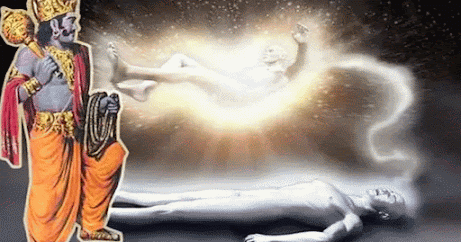
According to the Garuda Purana, when a person dies, the soul leaves the physical body and enters the subtle realm.
- Souls who committed sinful actions are taken to the world of Yama by messengers of death.
- Virtuous souls are guided by divine beings toward heavenly realms.
It is believed that the soul remains connected to the earthly realm for about 13 days after death, experiencing the consequences of its actions.
2. Judgment of Karma in Yamaloka
In the realm of the afterlife, the god of death Yama judges the soul based on its actions recorded by Chitragupta.
- People who performed good deeds are rewarded with heaven.
- Those who committed harmful actions must experience suffering in hell.
This teaching emphasizes the importance of living a life of righteousness and good conduct.
3. Types of Hell
The Garuda Purana describes 28 different types of hell, where souls experience the consequences of their negative actions. Some examples include:
- Kumbhipaka Hell – where those who caused harm to living beings are punished in boiling substances.
- Raurava Hell – for those who tortured innocent beings.
- Tamisra Hell – for people who stole wealth or property from others.
- Asipatravana Hell – where liars and deceivers suffer in forests of sharp leaves.
4. Importance of Shraddha and Tarpana
The Garuda Purana highlights the importance of performing Shraddha and Tarpana rituals for ancestors.
These rituals are believed to:
- Bring peace to departed souls
- Help the soul move toward liberation
- Maintain harmony and blessings within the family
5. The Path to Liberation (Moksha)
According to the Garuda Purana, liberation from the cycle of birth and death can be achieved through:
- Truthfulness
- Non-violence
- Charity and good deeds
- Devotion to Lord Vishnu
- Meditation and spiritual discipline
By following these principles, a person can move closer to spiritual freedom.
Conclusion
The Garuda Purana is not merely a text about death; it is a profound spiritual guide that teaches the importance of righteous living and moral conduct.
It reminds us that our actions shape our destiny, both in this life and beyond.
Therefore, one should strive to perform good deeds, follow the path of dharma, and seek refuge in Lord Vishnu to attain spiritual liberation.




Leave a Reply