
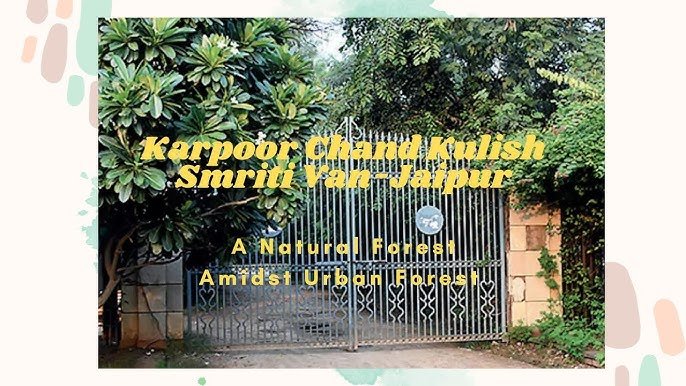
Kapoor Chand Kulish Smriti Van is one of the most beautiful biodiversity parks in Jaipur, located on Jawaharlal Nehru Marg. Today it is a peaceful green space filled with plants, flowers, and walking paths, but the story behind this place is deeply connected with nature conservation and remembrance.
History of Smriti Van
During the devastating floods of 1981, this entire area was submerged, and deep ravines were formed. Later, under the guidance of former Chief Secretary Shri Mitha Lal Mehta and renowned journalist and Vedic scholar Kapoor Chand Kulish, the area was developed by planting trees in memory of loved ones.
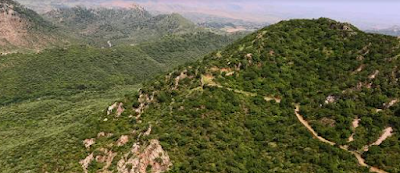
Under the “Green Rajasthan” campaign, the Rajasthan Government decided to transform this land into a biodiversity forest. The foundation stone of the park was laid by former Chief Minister Vasundra Raje on 8 October 2005. Around 54 hectares of land from the Jhalana-Kho Nagorian forest block was developed with the support of the Jaipur Development Authority (JDA), and the park was officially opened to the public on 8 December 2007.
Major Sections of Kulish Smriti Van
The park is beautifully divided into 11 themed sections, each designed to represent a unique part of nature:
1. Vasundhara Van
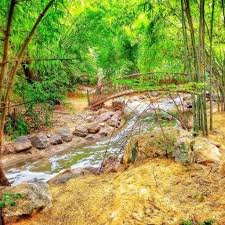
This is the main attraction of the park. Natural walking paths have been created in the ravine valleys, and flowering plants like Mogra, Champa, and Coral Tree have been planted along the paths. Small lawns provide peaceful spaces for relaxation.
2. Eco-Environment Museum
This section has four halls displaying photographs of birds, flowers, and plants found in Smriti Van. One hall is also used to show films related to nature and wildlife.
3. Vrindavan Van
A great example of ecological restoration, where slopes have been stabilized using natural techniques. Plants such as Mogra, Juhi, and Raat Rani have been planted to reduce foul smell and improve the environment.
4. Maru Van
This section focuses on desert plants. Cactus, Agave, Euphorbia, and other xerophytic plants have been planted here. Currently, the Euphorbia flowers are a major attraction for visitors.
5. Aravali Van
Plants found in the Aravali mountain range such as Dhak, Rohida, Khejdi, Gurjan, and Gugal have been planted here to represent the natural vegetation of Rajasthan.
6. Sarovar (Water Area)
Water from nearby areas is stored here in nine small ponds. Lotus flowers have been planted in the ponds, and fishes and ducks can also be seen. During winter, many migratory birds visit this section.
7. Rashtriya Van
This section includes plant species from across India such as Semal, Shisham, Mahua, Arjun, Ashok, and many flowering trees and shrubs. It represents the biodiversity of the entire country.
8. Champa Van
A unique garden where 108 varieties of Champa plants have been planted. These plants bloom in different colors and fragrances.
9. Java Kusum Van
This section includes 68 varieties of Gudhal (Hibiscus) plants collected from different parts of India. The colorful flowers attract many visitors.
10. Hi-Tech Nursery
A modern nursery has been developed to maintain high-quality plants and support future plantation work.
11. Dhanvantari Van
This is the largest section of Smriti Van, spread over nearly 40 acres. It has more than 225 species of medicinal plants such as Amla, Neem, Ashwagandha, Tulsi, Giloy, Sarpagandha, and Sandalwood. It is also known as the herbal garden of the park.
Why Kulish Smriti Van Is Special
Kulish Smriti Van is not just a park; it is a symbol of environmental conservation and emotional connection. People come here to enjoy nature, walk peacefully, and remember their loved ones. It is one of the best places in Jaipur for nature lovers, photographers, and meditation seekers. 🌳✨



Leave a Reply